
Powder Coating on Plastics
When it comes to powder coating, the question of suitable substrates frequently arises. Although metallic materials such as aluminum and steel are most commonly coated with powder coatings, the process is not limited exclusively to metals. Under certain conditions, plastics can also be finished with powder coatings, in addition to wood, glass, or ceramics. It is essential, however, to consider specific material- and process-related factors.
Which plastics can be powder coated?
Whether a plastic is suitable for powder coating depends on several influencing factors. Due to the wide variety of plastic types, a general statement can only be made to a limited extent. The following criteria are crucial:
- Electrical Conductivity of the Material
Plastics are naturally electrically insulating. If sufficient conductivity is not present, powder adhesion during application may be impaired. In such cases, special processes such as hot coating or a conductive pre-treatment—for example with TIGER Static Fluid—can be used.
- Surface Requirements
Visual appearance, haptics, mechanical durability, and chemical resistance all influence the selection of the appropriate powder coating and coating process.
- Temperature Resistance of the Substrate
The plastic must withstand the temperatures required for powder coating. Since thermal resistance varies significantly depending on the specific plastic type, component geometry, and intended curing conditions, an individual assessment is necessary. We are happy to support you with a technical evaluation and review together whether your component is suitable for powder coating.
Suitable materials include glass- and carbon-fiber-reinforced plastics as well as polyamides. However, as plastics differ widely in their properties, each application should be individually assessed and technically evaluated.
Powder In-Mould Coating (PIMC)
Composite materials are considered key materials for future applications due to their outstanding mechanical and structural properties. They are used in aerospace, automotive manufacturing, transportation, and energy production, among other industries.
TIGER Coatings offers innovative solutions for coating fiber-reinforced plastics. The goal is to create surfaces with high durability, premium quality, and convincing visual and tactile properties.
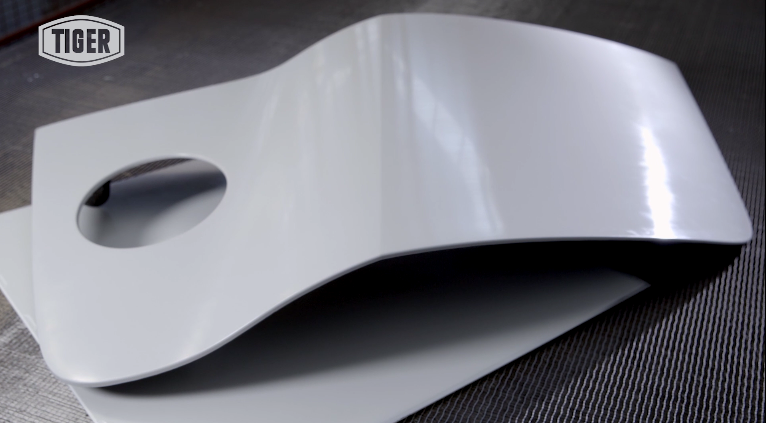
In the Powder-in-Mould-Coating (PIMC) process, a highly reactive powder coating is applied to a preheated compression mold, where it begins to gel immediately. The fiber-reinforced plastic material is then inserted and compressed. The component can subsequently be demolded with its finished coating already applied.
This single-step process is compatible with all common release agents and enables durable surfaces in Class A quality. Typical issues such as telegraphing—fiber print-through caused by temperature or moisture influences—are effectively prevented by the PIMC process.
Powder-in-Mould-Coating can be combined with all standard technologies used in the production of fiber-reinforced plastics. It is suitable for thermoplastic and thermoset FRP matrix materials, various fiber types, and complex geometries. Bio-composites based on sustainable raw materials are also compatible with the process.
For further information, please contact: pimc(at)tiger-coatings.com
Application Areas for PoP / PIMC
Structural and decorative parts for:
- Automotive manufacturing
- Aircraft manufacturing
- Railway industry
Components for:
- Sports and leisure equipment (e.g., bicycle frames, attachments)
- Electronic applications
- Nautical equipment
- Wind turbines
- Solar energy systems
Would you like to learn more?
The TIGER team will be happy to advise you personally: pop(at)tiger-coatings.com
TIGER Solutions
In principle, plastics can be coated with all more than 1,600 TIGER Drylac® stock products. For Powder-in-Mould-Coating, we recommend specially developed low-temperature powder coatings.
For carbon fiber components, a customized clear coat solution is also available, specifically tailored to the requirements of the automotive industry.
Since the suitability of plastics for powder coating can often be difficult to assess in advance, we recommend a case-by-case technical evaluation. At TIGER’s state-of-the-art Research and Development Center, different coating options can be tested directly on your components—ensuring a solution that precisely matches your application.