
Powder Coatings for Switchgear: Protection That Goes Beyond the Surface
Switchgear has a serious job. It controls, protects, and isolates electrical equipment so power can move safely and reliably through factories, commercial buildings, utilities, and data centers.
But what protects the switchgear itself?
Its enclosure takes the everyday punishment: humidity, dust, fingerprints, handling damage, and, outdoors, rain, sunlight, and corrosive atmospheres. A coating that starts to chip or corrode can become a maintenance headache long before the equipment inside reaches the end of its useful life.
That's where powder coatings for switchgear come in.
TL;DR: “Powder coating for switchgear enclosures creates a durable, cured finish on metal housings, doors, and panels. With the right pretreatment and formulation, powder coatings can help resist corrosion, physical wear, and outdoor weathering of switchgear enclosures while delivering consistent color and appearance. The right system depends on the substrate, exposure, and applicable equipment requirements.”
Not Every Switchgear Needs the Same Coating.
Why settle for a one-size-fits-all solution? Let's develop a powder coating that meets your exact application requirements.
Why Switchgear Coating Matters
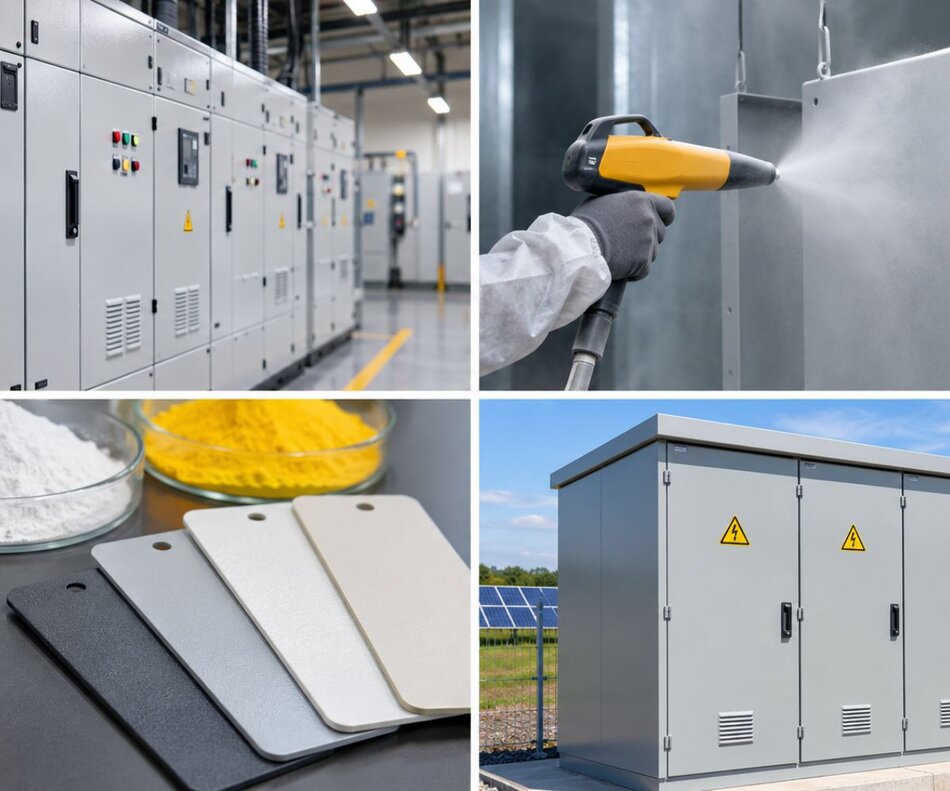
Most switchgear lives behind a metal enclosure. That cabinet does more than make the equipment look organized. Its construction helps separate people from energized components and shields the assembly from its operating environment.
The finish supports that enclosure by helping protect the underlying metal. If corrosion starts around a panel edge, hinge, or fastener opening, it can spread beneath a damaged coating. Repairing an installed cabinet is rarely as convenient as finishing it correctly at the factory.
And conditions vary. An indoor electrical room and an outdoor coastal substation don't call for the same switchgear coating specification.
Why Choose Powder Coatings for Switchgear?
1. Corrosion Resistance Where It Counts
Moisture and oxygen are bad news for exposed steel. Properly specified switchgear powder coatings form a protective barrier that reduces the metal's contact with these corrosion drivers.
But here's the catch: powder is only part of the system. Cleaning, substrate preparation, coating thickness, and cure all matter. For aggressive environments, a qualified corrosion-resistant primer and polyester topcoat, such as with the TIGER Shield System, may be a better choice than a single layer of powder.
2. A Tougher Finish for Everyday Handling
Switchgear doors get opened. Panels get removed. Cabinets are moved, installed, inspected, and maintained.
A properly cured powder finish can resist scratches, chipping, and impact during normal service. That doesn't make it damage-proof, but it helps preserve the protective surface through the practical demands of manufacturing and field use.
3. Outdoor Durability Without Sacrificing Appearance
Outdoor switchgear can face UV exposure, temperature swings, humidity, and airborne contaminants. Exterior-grade polyester powders are often chosen for their weatherability and color retention. Super-durable polyester options may suit applications with more demanding appearance requirements.
Indoor epoxies or epoxy-polyester hybrids can perform well in suitable environments, but conventional epoxies generally aren't the best exposed finish where UV stability matters.
4. Repeatable Finishes Across an Entire Lineup
There's something reassuring about a row of electrical cabinets that actually match. Powder coating offers manufacturers choices in gloss, texture, and color, including familiar industrial gray finishes, while supporting repeatable production when the application process is controlled.
TIGER Drylac® offers industrial ANSI/ASA color options, including commonly specified gray shades, in polyester powder coating formulations designed for electrical energy applications.
ANSI/ASA Safety Powder Coating Colors

ANSI/ASA -49, 61 & 70 Colors
5. An Efficient, Solvent-Free Application Option
Powder coatings are applied without the liquid solvent carrier used in many conventional paints. Recoverable overspray can also be reused in suitable systems, reducing material waste.
Of course, curing ovens consume energy, and pretreatment has its own environmental footprint. The meaningful comparison is the complete finishing process, not just the paint can.
Which Switchgear Components Can Be Powder Coated?
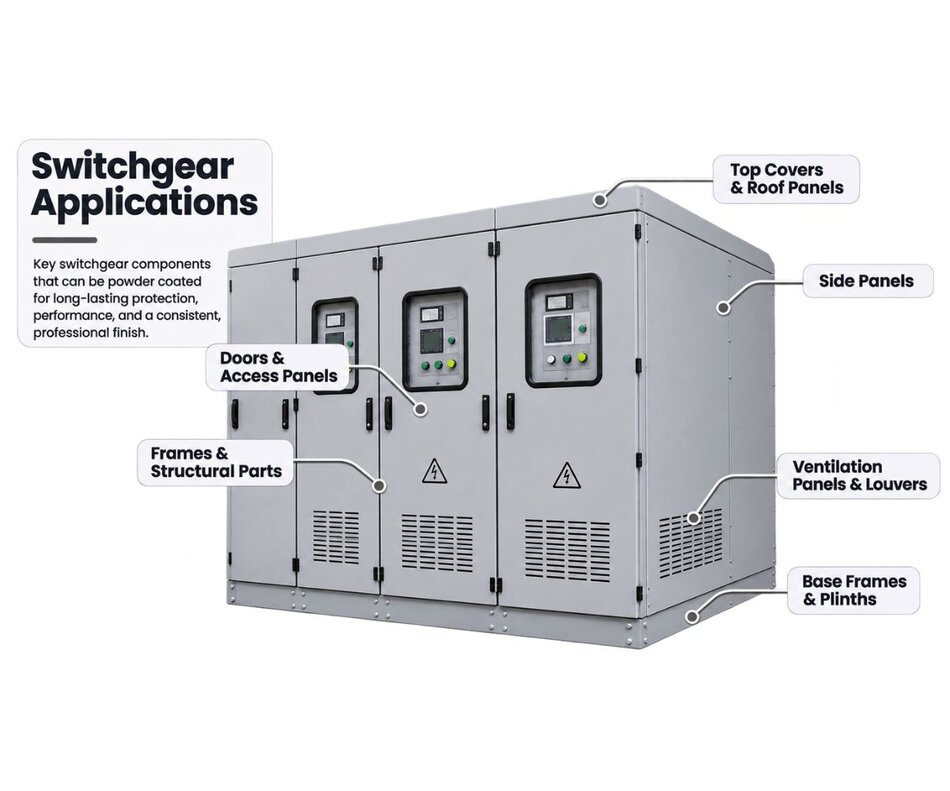
Powder coating for switchgear enclosures is typically used on fabricated metal parts such as:
- Exterior cabinets and enclosure walls
- Access doors and removable covers
- Side, rear, and roof panels
- Suitable internal partitions and sheet-metal compartments
- Bases, brackets, and supporting frames, where specified
Not every surface should be coated. Electrical bonding points, specified grounding interfaces, contact areas, threads, and other functional surfaces may require masking or a different treatment.
And don't confuse a standard protective powder finish with a certified electrical insulation system. Busbars and other energized parts require purpose-designed, validated coatings when electrical insulation is part of the specification.
Choosing the Right Powder Coating for Switchgear Enclosures
Indoor Switchgear
A suitable polyester, epoxy, or epoxy-polyester hybrid system may meet the finish requirements, depending on chemical exposure, wear, and performance specifications. If appearance and maintenance are primary concerns, a consistent, easy-to-clean surface matters.
Outdoor Switchgear
Start with UV-resistant polyester chemistry, then evaluate moisture, pollution, salt exposure, and expected maintenance. Exterior durability should be demonstrated for the selected system rather than assumed from the word "powder."
Coastal or Industrial Installations
Consider a corrosion-protective primer plus an exterior topcoat, with the substrate and pretreatment selected as a complete system. TIGER SHIELD, for example, pairs a powder primer with a powder topcoat for applications needing added corrosion protection.
Special Electrical Requirements
Where electrostatic dissipation or dielectric insulation is required, specify the relevant functional coating separately and verify its properties. These are different requirements, not interchangeable selling points.
What Does a Reliable Switchgear Powder Coating Process Look Like?
A successful coating is built before the first particle of powder reaches the part.
1. Prepare the Metal
Remove oils, contaminants, and oxidation. Use a pretreatment appropriate for steel, galvanized steel, or aluminum, and for the required corrosion performance.
2. Apply the Powder
Electrostatic spraying deposits charged powder onto grounded metal parts. Applicators must pay special attention to recesses, folded edges, and corners, where coverage can be tricky.
3. Cure and Inspect
Heat the part according to the coating's required metal-temperature and time conditions. Then verify film thickness, adhesion, appearance, and other agreed performance measures.
Here's a detail that's easy to overlook: a great-looking front panel tells you very little about coverage inside a tight corner. Those difficult areas deserve their own quality checks.
Powder Coating vs. Liquid Paint for Switchgear
Both technologies can protect electrical enclosures when properly specified and applied. Powder coating often offers a durable film in an efficient application process, with no solvent carrier and opportunities for overspray recovery. Liquid coatings can be useful for large assemblies that cannot fit an oven, heat-sensitive components, or field repairs.
Neither wins automatically. The better decision considers pretreatment, required performance, line capacity, total process cost, and repair strategy. For OEMs coating repeatable sheet-metal parts in volume, powder is often a practical fit.
Build Protection Into the Specification
A switchgear enclosure might look like simple sheet metal. It isn't. Its finish has to survive production, installation, and years in service without becoming the weak link.
TIGER Drylac® offers powder coating options for electrical enclosures, including industrial colors, exterior-durable finishes, and corrosion-protective two-coat systems.
Explore TIGER's electrical energy coating solutions or connect with a TIGER specialist to match the coating system to your switchgear application.
Frequently Asked Questions About Switchgear Powder Coatings
Yes, if it is specified or applied without considering the equipment's design. Bonding points must retain their required electrical continuity, and coatings must not obstruct vents, cooling passages, or service interfaces.
That depends on exposure, surface preparation, coating chemistry, film build, damage, and maintenance. Use tested performance and project requirements rather than a blanket lifespan claim.
There's no universal winner. Indoor cabinets, outdoor utility equipment, and coastal installations have different needs. Start with location, substrate, corrosion expectations, appearance, and applicable certification requirements.
Yes, when the coating system is matched to the exposure. Exterior-grade polyester and properly designed two-coat systems can protect outdoor enclosures, but substrate preparation, details, and maintenance still matter.