
Powder Coating on Glass – Tailored Solutions by TIGER
Clarity Meets Creative Freedom
Glass, like hardly any other material, stands for transparency, lightness, and openness. However, in many design and industrial applications, a purely transparent surface is not sufficient. Colors, effects, protective functions, or targeted light filtration are required. This is exactly where powder coating opens up new design and functional possibilities.
As an experienced powder coating manufacturer, TIGER offers extensive expertise and tailored solutions for demanding and specialized substrates such as glass. Due to the unique properties of this material, each project is developed individually and in close coordination with the customer.
Powder Coating Glass – Why Individual Solutions Are Necessary
Glass differs fundamentally from traditional metal substrates: it has no electrical conductivity and therefore places special demands on the coating process, pre-treatment, and application. Standard processes cannot be transferred without adaptation.
TIGER supports its customers with in-depth know-how and application expertise to achieve both functional and aesthetically high-quality coating results on glass. Whether and how powder coating can be technically implemented always depends on the specific application and is evaluated on a case-by-case basis.
Advantages of Powder-Coated Glass Surfaces
Customized Design Variety
From bottles and flacons to glass containers and furniture or kitchen elements: powder coatings offer a wide range of colors, gloss levels, textures, and effects—tailored to design, function, and application.
Enhanced Durability
Powder coatings form a protective surface that makes glass more resistant to scratches, abrasion, chipping, and other stresses of everyday use.
Functional UV Protection
In the cosmetics, fragrance, wine, and spirits industries, powder coatings often serve as a protective barrier against UV radiation—particularly UVA components that can pass through glass. This helps reliably protect the contents from light-induced degradation.

Typical Areas of Application
Thermally curing powder coating systems enable the finishing of glass components in industrial flat glass processing systems, including:
- Kitchen and interior fittings
- Bathrooms
- Office furniture
- Shopfitting
As always, feasibility and product selection depend on the specific application and are assessed individually.
Coating Processes and Key Influencing Factors
Application technology
Since glass is non-conductive, alternative methods are required—such as hot coating or conductive pre-treatment. TIGER has experience with a range of solution approaches that can be applied depending on component type, geometry, and requirements.
Pre-Treatment
Careful cleaning of the glass surface—ideally using distilled water—is essential to avoid visual defects, especially with transparent or light-colored coatings.
Object size
While small glass surfaces are relatively easy to handle, larger components significantly increase the demands on application and curing. Oven size and process control must also be taken into account.
Innovation: Digital Inkjet Printing on Powder Coatings
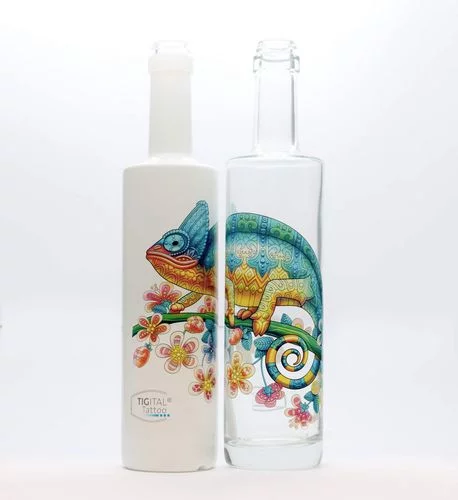
A growing trend is the combination of powder coating with digital inkjet printing. Solid-color powder coatings—such as white—serve as a high-quality base on which digital designs can be reproduced with exceptional brilliance. This technology opens up additional creative possibilities for customized designs and small production runs.
Glass presents unique challenges for powder coating—but also offers exceptional opportunities. With TIGER’s experience and expertise, tailored solutions can be developed effectively. The best approach is always determined through close collaboration.
We would be happy to advise you personally and explore how your glass project can be optimally realized.
Please note that powder coatings for glass applications are manufactured on a project-specific basis. Due to individual formulation and customization, production of powder coating for glass applications is exclusively made to order and no stock items are available. Accordingly, product-specific minimum order quantities apply.